Once in a Blue Moon: The Rise of Civil Daze


Civil Daze
Once in a Blue Moon: The Rise of Civil Daze
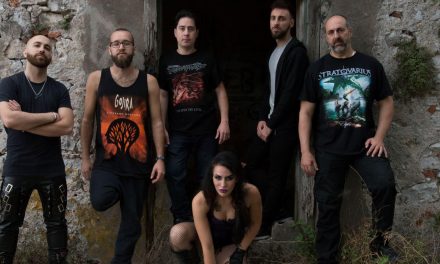
Sweden has never been short on rock pedigree, but Civil Daze arrives with a debut that feels both steeped in tradition and defiantly personal. Built around the songwriting vision of guitarist and multi‑instrumentalist Mikael Danielsson, the band’s first album Once in a Blue Moon is the culmination of years of writing, revising, shelving, resurrecting, and ultimately refusing to let good songs die in a drawer. With powerhouse vocalist Helena Sommerdahl bringing the melodies to life, Civil Daze blends the melodic punch of ’80s Heart and Whitesnake with the grit of classic hard rock — all wrapped in a sound that feels timeless rather than nostalgic.
I sat down with Mikael to talk about the long road to the album, the unexpected speed of signing with Pride & Joy Music, the influence of growing up in the same town that birthed Europe and Candlemass, and why he’s already thinking about album number two. What follows is a candid, funny, and refreshingly honest look at a musician finally releasing the record he’s carried with him for more than a decade.
We’re here with Mikael from Civil Daze. First of all, your debut album Once in a Blue Moon is finally out after years in the making. How does it feel to see this project come to life?
Thank you for having me. It feels really good — very nice, actually. As you said, it’s been going on for years. Of course, it hasn’t been a full‑time project. When you don’t have a band up and running, you tend to leave the songs in a drawer for a while, then come back to them six months later, do a bit more, and suddenly you have half an album. Then life happens — pandemics, divorces, everything. That’s why it took so long.
But it feels awesome now, because this is the most personal thing I’ve ever done. I don’t want to say it’s all me, but it’s mostly me. I’ve put a lot of personal time into every part of the process to make it happen.
You originally started Civil Daze as a solo project. What changed when Helena joined as a vocalist, and how did her voice reshape the songs?
First of all, she made them better. She’s amazing, and she lifted the songs a few notches right away.
Yes, it started as a solo project, but I never wanted it to be a solo or one‑man thing. I come from the band generation — rehearsing together, writing together, playing live. That’s what I’m used to and what I wanted. But we’re all pretty old now, and I’ve been in tons of bands. I used to say a band is like a company with five employees, and everyone is the boss. It’s totally democratic, which is good, but also bad. Sooner or later people want different things, arguments start, and often the band splits up. Songs you wrote never get recorded because someone quits or gets fired or whatever.
So it became a solo project simply because I wanted to be in control enough to make sure the work didn’t disappear. I wanted it to be finished. I joke that I wanted to be the dictator — I really don’t — but having one person responsible means the project can continue no matter what.
When Helena joined, I already had some songs written. We played together in a cover band, so I asked her to try a few. And everything changed. She sings exactly the way I imagine the songs in my head. When she opened her mouth, I thought, “Yes — that’s it.” She feels like she’s just doing her thing, adding her personal touch, but that touch is exactly what I envisioned. She brought the songs up ten notches.

Once In A Blue Moon by Civil Daze
Where you’re from — Upplands Väsby — has legendary bands like Europe, Candlemass, and even H.E.A.T. Do you feel inspired being part of that musical lineage?
Mikael: Absolutely, especially when it comes to my upbringing.
Here’s a short story to explain it: when I got my first real electric guitar and amp and started my first band, it was just me and a drummer. We were 14 or 15, trying to write songs and rehearse. And then, when I was 15, Europe released The Final Countdown and suddenly had a massive worldwide hit.
These were guys who went to the same school — I didn’t know them personally because they’re about eight years older — but it had a huge impact. Everyone around us was playing guitar, idolizing the big hard rock heroes, and suddenly the local guys became international stars. They won a rock competition in Sweden, got a record deal, and by their third album they were global. So of course we thought, “Okay, we can do this too. We’re going to be international rock stars.”
Candlemass had the same kind of influence. And Yngwie Malmsteen lived here for a while — he’s not from here originally, but he spent a lot of time in the area before moving to the U.S. This was where most of the musicians were.
I was a bit too young to see the classic gig where both Europe and Yngwie played at my old school around 1981. I was only ten. They had no record deals yet — just local kids, 17 or 18 years old, famous only around Stockholm. That would’ve been an amazing show to see.
How did you wind up on Pride & Joy Music and working with Birgitt?
That actually happened very fast. The record and the songs took years to finish, but once things started moving, they moved quickly. I have a friend, a great keyboard player in the prog scene — and another friend, Christian Liljegren from the Swedish band Narnia. Christian liked the material and said, “You have to do something with this. You need to release it.”
He put me in contact with Birgitt because he knows her and has worked with her before. And she basically said within a day, “Yes, we want to release this.” Just like that. I thought, “Why didn’t I do this 30 years ago?”
From there, everything sped up. Suddenly I was in a hurry to get the final mix, mastering, cover art, and booklet done. Once the label was on board, the whole process became very fast.
What made you decide to call the album Once in a Blue Moon? Is there a story behind the title?
I’ve always liked the expression “once in a blue moon,” meaning something that happens very rarely. And since I’d been working on this album for so long — some of the songs are more than ten years old — it felt fitting. It’s rare that I release something that is so completely me, where I wrote all the songs and played most of the instruments.
I’ve read some reviews where people interpret the title differently, saying it’s rare that an album this good comes out. That’s a nice interpretation too!
As for the cover, someone asked me about the exploding watch. It has nothing to do with a blue moon. I connected it more to the idea of time — that so much time passed that even the watch exploded. Even time itself was shocked that the album was finally finished.

Civil Daze
Your first single, “Top of the World,” has a great energy. Tell me about that song and the inspiration behind it.
It’s one of both mine and Helena’s favorites. It’s rougher, more straight‑ahead hard rock — a bit of AC/DC riffing, a bit of Status Quo‑style rhythm guitar. From the beginning, it was supposed to hit you in the face immediately with drums. But since it opens the album, we thought we needed a short intro so people wouldn’t get blasted if their volume was too high.
So I added a little countdown as a nod to our own history — Europe, The Final Countdown, and our hometown Upplands Väsby.
Lyrically, it’s meant to be straightforward, kick‑ass, sexy rock and roll. It’s more of a sex lyric than a love lyric. When Helena sings it, it’s a bit cheeky — like, “Hey man, can you give me an orgasm or not?” It’s that attitude of, “I don’t care much about you, but come here and do your thing.” Fun, bold, and unapologetic.
One of my favorite songs on the album is “A Million Miles Away.” Tell me about that one and what inspired it.
That’s probably the oldest song on the album — the first one I wrote in this style. I’ve been in other bands, mostly in the heavier genres. I love the melodic ’80s stuff like Europe, Bon Jovi, and Heart, but my first heroes were Iron Maiden. I’m a big fan of ’80s power metal and heavy metal — Maiden, Judas Priest, Helloween — and I’ve played in bands like that.
But at some point I felt like, “Let the melodic stuff come out now.” And “A Million Miles Away” was the first result of that. It actually came after we did a tribute band contest many years ago where we performed as Heart. That inspired me to start writing in that style.
The good thing about not chasing modern radio pop is that it doesn’t matter if a song was written in 2010 or 2025 — the style is timeless. ’70s and ’80s‑influenced rock doesn’t age the same way.
I still feel there’s a bit of magic in that song. These days I challenge myself to write choruses as strong as “A Million Miles Away,” and that’s not easy. I’m very proud of that hook — it’s a real hit chorus if you ask me.
One band you were in was Heart Attack. Are you still doing Heart Attack, and how has Heart influenced your music?
Yeah, that was the tribute band I mentioned earlier — Heart Attack. We did a Heart tribute competition, and after that we kept going under that name. We focused mainly on ’80s Heart. “All I Wanna Do Is Make Love to You” is ’90s, but songs like “Alone” and “If Looks Could Kill” — that era — that’s what we leaned into.
They’ve influenced me a lot, especially that melodic ’80s period. It’s funny, because from what I understand, Heart themselves don’t really like that era. The record company brought in outside songwriters, and the band became more of a polished product with less blues‑rock and more big melodic hooks. But those are my favorite Heart albums.
I’ve said before that if I had to describe Civil Daze’s sound in one sentence, it would be: If it sounds like a mix between what Heart and Whitesnake were doing in 1985, then we’re on the right track.

Mikael Danielsson of Civil Daze via Zoom!
Are you involved with any other bands or projects outside of Civil Daze?
No, not at the moment. Helena and I play in a couple of cover bands to get gigs and earn some extra money. One is an ’80s hard rock cover band she does with our bass player, and sometimes both of us play together with our drummer. I’ve shared the stage with the other guitarist a thousand times. We’re all very experienced — mostly through cover bands over the last 30 years.
I also spent some time in a Swedish band called Nubian Rose, playing bass for some gigs between their albums. I’m not on any of their records and didn’t write for them, but they’re a cool band — you should check them out.
Before that, I did more power metal and wrote songs in that style. We had a band called The Rough Diamond, which later changed its name to Cardinal Sin after I left, and they released an album. That was more big, produced power metal.
Right now, I’m not in any other bands. For the last two or three years, I’ve been working as what we call a trubadur in Swedish — basically a solo singer‑guitarist playing pubs and restaurants. That’s been my main job.
Will there be a Twice in a Blue Moon album? In other words, are you going to do more?
Absolutely. We already have some songs started — not finished, but ideas are there, and a few things are semi‑recorded. And now that the album has been out for almost a month, reading all the nice reviews has been really inspiring. I’ve got lots of new ideas coming.
We’re a band now. Maybe this first album was very much me — maybe even a bit of an ego statement — but the next one won’t be like that. I have no problem with other people writing songs. Maybe this album was me proving to myself that I could do almost everything on my own. Now that I’ve done that, I don’t need to prove it again. The next album can be more of a band effort.
I won’t give a date or year, but I hope we’ll be working on a new album very soon. It also depends on gigs — it’s hard to get festival spots when you’ve only released one album.
Hopefully that happens, and hopefully we see you here in the States one day. That would be amazing.
Yeah, that would be amazing. That’s definitely on my bucket list. I mean, I’ve made a real record now — a real CD. I’m old‑school, so even if nobody buys CDs anymore, it still feels like the real thing. Writing the songs and releasing a proper album — that’s been at the top of my bucket list.
And now, to be able to say one day that I’ve been on a U.S. tour, or at least played in the United States — that would be huge. I really hope that comes true.
In Conclusion
As Once in a Blue Moon makes its way into the world, it’s clear that Civil Daze is far more than a long‑delayed passion project — it’s the sound of an artist finally giving himself permission to create without compromise. Mikael Danielsson’s journey from half‑finished demos to a fully realized band has been winding, unpredictable, and at times interrupted by life itself, but the result is a debut that feels lived‑in, heartfelt, and unmistakably his. With Helena Sommerdahl’s voice elevating the songs and a renewed sense of purpose driving the band forward, Civil Daze is already looking toward the future, sketching out ideas for album number two and dreaming of stages far beyond Sweden.
Whether or not that long‑hoped‑for U.S. show becomes a reality, Once in a Blue Moon stands as proof that some records are worth waiting for — and that sometimes the rarest things shine the brightest.
(Interview by Ken Morton)
Civil Daze on Facebook