GodBoy in Focus: Ryan Woods on Music, Meaning, and the Messy Middle

 GodBoy in Focus: Ryan Woods on Music, Meaning, and the Messy Middle
 GodBoy in Focus: Ryan Woods on Music, Meaning, and the Messy Middle
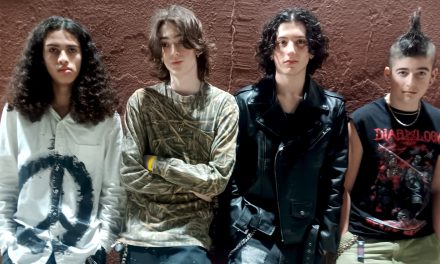
On the eve of his debut album GodBoy dropping via Fearless Records, Ryan Woods sat down with us at a Jack Lue photo shoot — a fitting backdrop for an artist whose music is as visually evocative as it is emotionally raw. Between camera flashes and candid moments, Ryan opened up about the existential weight behind GodBoy, the viral success of “Bad Texter,” and the quiet power of kindness through his work with Hope Unite. What unfolded was a conversation that blurred the lines between confession and connection — a portrait of an artist navigating the chaos of his twenties with vulnerability, humor, and a whole lot of heart.
We’re here with Ryan Woods at the Jack Lue photo shoot. First off, what do you think of the Los Angeles music scene, and how do you feel you fit into it?
I love it. I think it’s the best in the world. There’s nowhere else with this many creative people at every level. There’s no shortage of folks looking to work, collaborate, and just make art. It’s a huge contrast from my hometown — Knoxville, Tennessee — which is more of a college town. There, it’s mostly underground basement shows, bars, backyards, and then suddenly an arena or stadium. There’s not much in between, especially for artists like me. So, there’s a gap in how artists grow. Since moving out here, I’ve just met so many people and fallen in love with every corner of the scene.
 You moved here in 2019 — and then the pandemic hit. What was that experience like?
Honestly, there was a lot of regret and doubt at first. I moved here in December 2019, so I had about four months of peace before everything shut down. But I don’t look back on it as a terrible time. I think it helped that everyone was going through the same thing — it kept me from pitying myself too much. It was hard, though. As soon as it became clear things were going to be shut down for a while, I decided to write as much as I could. No one was going out, no one was playing shows — I had time to sit in solitude and create. I ended up writing close to 500 songs during those two years. Some of them barely count as songs, but this new project is built from my favorites during that time. I’m just grateful I made it through and kept going.
You recently played The Echo. How did that go, and what stood out for you?
It was amazing. I think most artists would agree — playing live is the most rewarding part of being in music. You get to see the real-life impact you’re having. Fans come up and tell you how they found your music, how a song helped them through a breakup or a tough time. That’s the highlight — it’s validating. As an artist at my level, you’re constantly wondering if you’re going to break through. It’s a saturated market, especially here, and we’re all trying to climb to the next level — and then the next after that. It’s easy to stress about whether you’re doing the right things to get there.
But when I’m on stage, I don’t worry about any of that. People paid money to watch me goof around — that’s wild. Even one person showing up is cool. Filling a room? Even cooler. And when people are screaming lyrics back at me — that’s the best part. It takes me back to the first show I ever went to, just being in awe. I think that’s where it starts for everyone in music — you go to that first concert, and you’re hooked on that feeling forever.
 Your new album, GodBoy, drops today on Fearless Records. Is there a concept behind the title and the song?
Yeah — it’s a loaded title. It means nothing and everything at the same time. I’m still figuring out how to describe it, but GodBoy is kind of a character I created — a version of my conscience. It’s the part of me that’s always asking: Am I doing the right thing? What’s my place in the world? Who am I? What am I meant to be doing? All those existential questions you wrestle with in your twenties.
I was raised religiously — went to church, played in worship bands — and that gave me a strict conscience. I was hard on myself, always chasing perfection. That became the backbone of my anxiety: worrying if every breath I took was moving me closer to where I wanted to be.
That mindset shows up in relationships too — am I loving this person right? Do I feel loved? Are my needs being met? Am I meeting theirs? Same with friendships — I want to be a good friend, someone who’s there. It’s a people-pleaser mentality rooted in that religious upbringing. So, each song on the record comes from that place — searching for the balance between good and bad, zooming out, trying to see both sides. That’s why GodBoy is the title track — it’s the umbrella concept, and each song is a piece of that puzzle.
Your song “Debbie” has been living rent-free in my head for weeks. What inspired it?
That one has a double meaning — honestly, a lot of my songs do. I don’t write critically about someone else unless I’ve been in that place too. I wrote “Debbie” during a two-week depressive funk. I couldn’t explain it — I just felt awful for no reason. Didn’t want to do anything, didn’t want to talk to anyone. It was like my demons were visiting. The line “I just spent the week with Debbie Downer” is me personifying depression — hanging out with someone who’s draining all your energy.
I didn’t finish the song for another year or two — just sat on the idea. Then I was in a relationship that lasted about eight months. One reason we broke up was that she was very fear-driven. Her choices were made to avoid things, not to pursue passion. I’ve been that person too, and it took me a long time to fight that part of myself.
 So “Debbie” became a concept — sadness, depression, anxiety. Those emotions that don’t always have a clear source. You’re just anxious, and you don’t know why. Maybe too much coffee, maybe something deeper. It’s about recognizing that pattern and breaking away from the Debbie Downer in your life — whether that’s someone else or the Debbie inside you.
Let’s talk about “A Gun in the Glove Box.” What’s the story behind that one?
That one’s interesting. It’s loosely based on true events, but mostly a story I made up. My parents always taught me not to snoop through people’s stuff — and for some reason, the glove box always felt off-limits. People keep random things in there, but it’s also symbolic.
To me, the glove box is a metaphor for the things you lock away — past experiences, insecurities, stuff you don’t want others to see. The song’s about being in a relationship where things are going well, but the pace feels fast, and the other person is getting curious. You’re trying to manage how much of yourself you reveal — keeping it at a healthy flow.
The “gun in the glove box” could be something simple, like them asking “What are we?” and you’re like, “Whoa, are we there yet?” Or it could be pressure you’re putting on them. It’s all heady and open to interpretation, but at its core, it’s about finding the balance between vulnerability and self-protection — opening up without getting hurt more than you need to. It’s a fun one.
“Bad Texter” has 28 million plays on Spotify. What does that number even mean to you? Can you imagine 28 million people in a room?
Yeah, I know — it doesn’t feel real sometimes. It was the first song I ever released, and funny enough, it was the one I cared about the least from that project. That’s usually how it goes, right? The silly, throwaway track ends up being the one that puts you on the map.
 I started writing it when I was 17 — it was just a chorus for the longest time. Later, I was in a writing session with a producer, digging through voice memos and notebooks, and I stumbled on it. I was like, “This sounds boppy. Maybe it could do something.” But I never imagined it would go this far.
Now I get calls from friends back home saying, “I just heard your song in Walmart,” or at the mall, or in some random restaurant. It’s surreal. I think we make art from this primal need to say, “I was here. I existed. I did something.” And this song is proof of that. I feel really blessed that it’s connected with so many people.
Tell me about Hope Unite and how you got involved.
Hope Unite is a mental health organization focused on spreading kindness. Their slogan is “One act of kindness a day goes a long way,” and it’s true — you can turn someone’s whole day around just by holding a door open, offering a piece of gum, picking up the tab. Simple stuff.
Beyond that, they run a mental health crisis hotline, help people find therapy or community support, and even assist with job placement and housing — especially for folks experiencing homelessness. Basically, if it’s an act of kindness, they’re doing it.
Crystal, who runs the organization, is actually an old family friend. She used to cut my hair when I was ten. Our families stayed in touch, and when I heard she was starting Hope Unite, I knew I wanted to be involved. Mental health is a huge topic for me — not just personally, but in my family and friend circles. It’s one of the reasons I got into music. Writing helped me understand what I was going through.
I’ve always wanted my music to do more than just chase fame. I believe music alleviates suffering. It brings people together. I’ve never felt more love in a room than at a concert — like a Harry Styles show, where the energy is just bursting with love. I want to be a vessel for that. Working with Hope Unite has helped me do that in a real way.
 Do you have a message for your fans — for people reading this right now?
Ryan: I think the message is in the music. I’ve got a lot of little one-liners I live by — “Gun in the glove box.” “If you don’t like the smell of shit, don’t sniff it.” Stuff like that.
Surround yourself with people you love, people who inspire you and lift you up. That’s what those lines mean. My latest single, “Too Many Ways to Live,” is about how overwhelming life can feel — so many paths, so many choices. You can feel lost, out of place. I got through that by learning to tell myself, “I’m exactly where I’m supposed to be.” Because if I wasn’t meant to be here, I wouldn’t be here. In the most profound way, I wouldn’t be sitting on this couch right now if it wasn’t meant to be.
So yeah — love where you’re at. Be kind. Love others. Be cool. Don’t annoy people.
Honestly, if everyone lived by those two rules — be cool and don’t annoy people — the world would be a much more peaceful place.
(Interview by Ken Morton – Photos by Jack Lue)