


Into the Fallen Dimension: Rexoria at Ten Years Strong
 Into the Fallen Dimension: Rexoria at Ten Years Strong
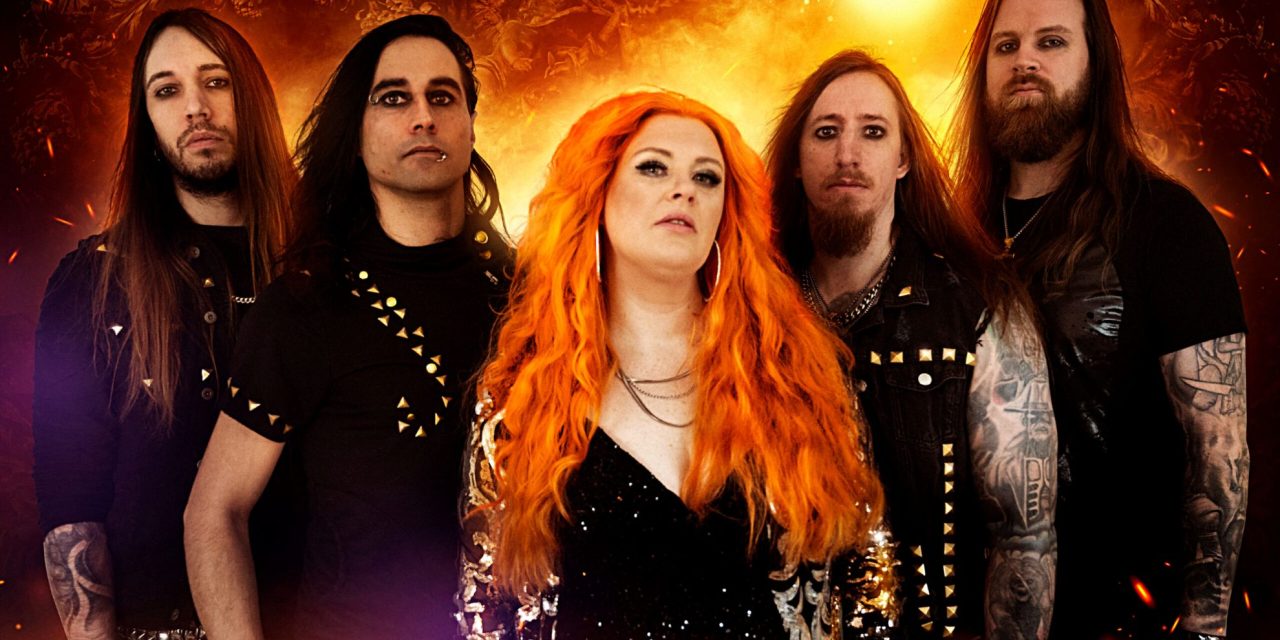
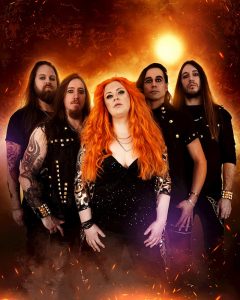
Ten years into their journey, Swedish melodic metal force Rexoria steps boldly into a new era with Fallen Dimension — a record forged in resilience, sharpened by evolution, and delivered with the kind of conviction only a decade of battle can produce. Vocalist Frida Ohlin and guitarist Jonas Gustavsson speak with the fire of artists who have weathered storms, rebuilt worlds, and emerged stronger. From unexpected duets with Johnny Gioeli and Mike Andersson to a triumphant appearance at Sweden Rock, Rexoria stands ready to carry their sound far beyond Scandinavia — and hopefully straight into the hearts of fans in the States.
We’re here with two members of Rexoria. Introduce yourselves and tell me what you do in the band.
Frida: My name is Frida, and I’m the singer in the band. I also co‑write the songs together with this guy.
Jonas: And I’m Jonas. I play guitar — mainly lead guitar — and I’m the second co‑writer alongside Frida.
Where is the band based, and what is your local metal scene like there?
Jonas: We’re in the south of Sweden, somewhere between Malmö and Stockholm. The metal scene here… well, we’re basically in the middle of nowhere. It’s really countryside, and honestly, the scene around here isn’t that great anymore. I think it used to be better back in the day, but not so much now.
Frida: Yeah, like Jonas said, we live out in the countryside, so there isn’t much happening nearby. Before, there were more venues and shows even in the smaller towns closer to us. But now everything has become more concentrated in Stockholm, Malmö, and Gothenburg. A lot of venues shut down after the pandemic — that was kind of the final blow — and things never really picked up again. It’s sad, because Sweden has so many great bands you’d love to see, but there just aren’t enough venues anymore.
 Let’s talk about the new album, Fallen Dimension. Is there an overall story or concept behind the title?
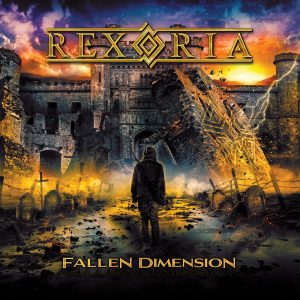
Frida: The title came after we had finished all the songs. None of the individual tracks felt like the perfect album title, so we looked at the whole record — the themes, the lyrics — and realized there were a lot of dark and dystopian elements. That’s when Fallen Dimension came up.
It’s also represented in the artwork by Jobert Mello, who we’ve worked with a lot. He painted this “fallen dimension” — the last battle, standing up for yourself, going through something difficult. And after you’ve gone through that darkness, there’s a sunrise. It reflects the world today too: even if things feel dark right now, hopefully they’ll change for the better.
Let’s talk about a few of the songs. Starting at the beginning of the album: “Metallic Rain” and “Awakening.” Tell me about those tracks and the inspiration behind them.
Jonas: “Metallic Rain” was actually the song that was never supposed to be written. We were done with the album — songwriting finished, recordings done — and we were celebrating. Then I went through the files and realized, “Frida… we only have ten songs. We said we’d have eleven.” So suddenly we had to write a new one.
This was in the middle of the night, and Frida just said, “Do something aggressive.”
Frida: I was frustrated — I said, “Just make something hard!”
Jonas: So I sat down, and it didn’t take long — maybe 50 minutes — and I came up with something. Frida kept saying, “Make it faster, make it faster,” so we ended up about 30 BPM faster than the original idea. The main riff came quickly, and then the verse, pre‑chorus, and chorus were done in maybe 20 minutes. My brother was here too, and he played the drums almost exactly as they are on the album. Once it came together, we knew immediately: this has to be the opener.
Frida: Yeah, and when we added the war‑themed intro, it really set the tone for Fallen Dimension right away. It worked perfectly. “Awakening” was written earlier in the process, and Jonas was really surprised by the chords.
Jonas: Yeah, the chords in the chorus! When she sent me the keyboard and vocal demo, I usually figure out the chords instantly, but this time I was like, “What is happening here?” We met up and went through it together. I kept asking, “Can you play this? Can you make it sound like this?” My brain just didn’t want to process it — but somehow it turned out great.
Frida: There’s a little flip in the middle of the chorus that we’ve never used before — ever. But it really worked. The verses are darker, and then the chorus becomes more upbeat and bright. I really like how it turned out.
 Let’s talk about the single, “Break the Wave.” That’s the track most people have probably heard by now. Tell me about the song and the inspiration behind it.
Jonas: I think that was the second‑to‑last song we wrote. It came together really easily — it’s what we call a “Rexoria song,” very true to our identity. At first, we didn’t think it would be a single, but the more we worked on it, the more we realized it actually could be.
Frida: Yeah, both the melody and the music felt strong, and we also wanted to make a music video. This song had the power and energy we wanted visually. So that played into choosing it as a single — and especially as the first single. It shows that we’ve developed, but we’re still Rexoria. Then the second single is a bit outside our usual range, so releasing “Break the Wave” first was also a strategic choice.
Mike Andersson of Tungsten appears on the song “Dominion.” What was it like working with him?
Frida: Really easy — he was such a fun, positive guy. We reached out because we wanted a duet for that track. We hadn’t planned on having two duets on the album; we had talked about doing one for the ballad, but not for “Dominion.” But once Jonas came up with that heavy riff and darker groove, I felt like we needed a male vocalist to carry those darker parts.
Tungsten had just released a new single, and when we listened to it, we thought, “This could be cool — maybe we should ask him.” We already had a bit of contact since we’re all Swedish metal musicians, so we wrote to him. He was totally up for it, loved the song, and within 48 hours he had sent back all the files — lead vocals, backing vocals, everything. Super cool, super easy to work with.
We’ve talked a lot since then too. He’s been checking in, asking how things are going, and looking forward to the album. Working with him was really fun.
You also have another guest appearance at the end of the album: “Heart of Sorrow,” featuring Johnny Gioeli from Hardline and Axel Rudi Pell — one of the most underrated rock and metal vocalists today, in my opinion. How did that come about, and what was it like working with him?
Jonas: “Heart of Sorrow” was actually the first song we wrote for the album. We wanted this record to show that we’ve developed as musicians — to push ourselves. We had never done a ballad like this before, so we decided to start with it and really work it through.
As we were writing it, both Frida and I felt it had a vibe that reminded us of Hardline and Axel Rudi Pell — and we’re huge fans. So we thought, “Maybe we should try to contact Johnny.”
Frida: Yeah, and the lyrics are about heartbreak — it’s called “Heart of Sorrow,” after all — so it felt natural to have a male and female voice singing to each other. I explained that concept to him over email. He was really funny and very kind, but it was harder to schedule because he’s constantly touring.
He’d say, “I’m going on tour for three months, maybe after that,” and then he’d come home and immediately have to head out again. But eventually it worked out, and he even wanted to be in the music video. He really liked both the video and the song when we sent them over.
And honestly — I don’t want to brag — but when we heard the first mix and got goosebumps, we knew we had created something special.
 It would be amazing if you and Johnny could perform it live someday. That would be something.
Frida: That’s a big dream. We actually talked about maybe joining them on tour, but they already had a support act booked. We’ve also talked about how incredible it would be to end our set with that song and have him come out for the duet — even if it’s just once, just to capture it on video. That would be so cool.
Your album was mixed and mastered by Jonas Kjellgren, who’s been in some of my favorite bands — Carnal Forge, Centinex, Scar Symmetry, and more. What was it like working with him?
Jonas: From the very beginning, we knew what he was capable of. He’s done so much mixing and mastering for the whole Sabaton camp and many others.
Frida: He had just finished Sabaton’s latest release, so yeah — he knows his stuff.
Jonas: He was incredibly easy to work with. We chatted through Messenger, and he responded quickly and understood everything we wanted. If we needed something changed in a song, he fixed it right away. Very easygoing, very professional.
Frida: And it helps that we could speak Swedish with him. You can express certain details more clearly in your own language — things that are harder to explain in English. He’d send a preview in the morning, we’d give feedback, and within half an hour he’d send an updated version. By lunchtime, it was done. Super fast, super fun to work with.
You recently played the Sweden Rock Festival. What was that experience like, performing alongside all those bands?
Frida: Amazing!
Jonas: Yeah, it was really cool. We had some issues with our wireless guitar systems at the shows before Sweden Rock. We ordered new ones from Germany and got them two days before the festival — and we never had time to test them. So my biggest concern was just making sure everything worked.
Once the soundcheck went well, I felt relieved and thought, “Okay, let’s just enjoy this.” You never know if or when you’ll get this opportunity again. And then seeing that huge crowd — not all of them, but a lot of people — singing along, and watching more and more people come in instead of leaving… that felt amazing.
Frida: It was funny because we knew we were playing at the same time as Journey, who were headlining that day. So we thought, “Okay, this might be tough.” During soundcheck, we were in this huge tent, and there were maybe five or ten people wandering around near the merch. We said, “If 50 people show up, at least we can say we played Sweden Rock.”
We left to get ready, came back — and it was thousands. People were packed inside the tent and standing outside too. It was crazy. Even the festival guards told us afterward, “We wanted to see you, but we couldn’t get through the crowd.” It’s an experience that stays with you for life.
Jonas: Definitely.
 You toured with Sirenia, Amberian Dawn, and Dark Sarah. That’s a bill I wish would come to the States. What was that experience like?
Jonas: It was a very special experience — especially for me — because one month before the tour started, I cut my thumb almost completely off. Not fully, but enough that it required surgery and a cast. This happened in mid‑August, and the tour started September 1st. So we had to find a solution.
I had a few days before surgery to record some remaining guitar parts so we could put them on backing tracks. Then I started learning keyboard, because we have keyboard parts in our songs — and I had never played keyboard before. There wasn’t much time. And to make it worse, the keyboard I ordered was delayed by almost a week. So we had one rehearsal together before the tour.
Frida: You’re always dealing with technical stuff at the last minute — and somehow it always works out.
Jonas: Yeah, it worked. In the middle of the tour, they removed the cast, but I still wasn’t allowed to use my hand or arm because it could ruin the surgery. So for me, it was a very unusual tour. But overall, it was great.
Frida: The funny thing is, we thought people would be upset that Jonas wasn’t playing guitar — he’s the lead guitarist, after all. But the crowds were so supportive. Every time he explained the situation, they cheered. People told us afterward how great it was that he still came out and performed.
And touring with Sirenia, Amberian Dawn, and Dark Sarah was amazing. Mostly Scandinavian and Finnish musicians — Norwegian too — so we understand each other’s cultures. On a long tour, living on a bus together, you really need to get along, and we did. We gained a lot of new fans on that tour.
Has Rexoria ever played in the States? If so, what was the experience like?
Frida: No, unfortunately not. We actually had a sort of helper/manager in Florida who was really eager to bring us over. He even wanted us to stay at his place so we could play local shows. But he passed away about a year ago, which was really tough. So nothing came of it.
Of course, it’s more expensive and the logistics are harder. You really need to know you can bring people to the venues. But hopefully after this album — and maybe with a booking agency — we can finally make it happen. It would be really, really cool to play in the States.
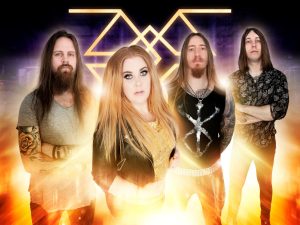 This is your 10‑year anniversary as a band. What goes through your mind knowing you’ve been doing this for a decade?
Jonas: I’m still surprised we can get along — but here we are, still in the same room. (Laughter)
Frida: We’re basically like family at this point, so we have to keep going. Ten years is a long time, but it also feels shorter because three of those years disappeared during the pandemic. We couldn’t tour, couldn’t go to shows, couldn’t do anything.
Jonas: And of course, we didn’t write many songs — even though we had a couple of children during that time.
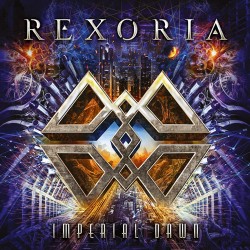
Frida: But it was a good pause to evaluate how we wanted to move forward. After that came Imperial Dawn, and we felt like we were finally heading in the right direction. So yes, ten years — but also kind of seven years. Still a long time. And since Jonas isn’t getting any younger, we have to be famous by now! (laughter) Hopefully we can get out and play more shows.
What do you hope the rest of the year brings for the band?
Jonas: I hope the album does well and reaches a lot of people. And I hope we get a great tour so we can keep the momentum going and push these songs even further.
Frida: Staying in the momentum after the release is important. We’re in discussions about possibly touring later this year, so it would be great to sign that deal. We’re also ready for summer festivals and local gigs — then hopefully head out to other countries and play this album. That would be the perfect storm for 2026.
Do you have any messages for your fans in the States who are reading this now?
Frida: Absolutely. It’s funny — we actually have a lot of listeners from the States. When I check Spotify, the U.S. is always in our top two or three countries. I really hope we can come out there someday and meet everyone live. That would be so cool.
And if people keep talking about us, sharing our music, and spreading the word, it helps so much. The more listeners we have, the easier it is to feel confident that it’s time to head over — that people will come to the shows. So just keep listening, keep spreading the word, and we hope you’ll love Fallen Dimension.
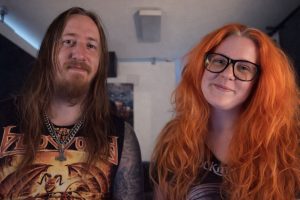
Jonas and Frida of Rexoria via Zoom!
In Conclusion
A decade into their journey, Rexoria stands as a band sharpened by challenges, strengthened by chemistry, and driven by a vision that only grows bolder with time. With Fallen Dimension, they’ve carved out their most ambitious chapter yet — one shaped by late‑night songwriting breakthroughs, unexpected collaborations, and the kind of perseverance that turns setbacks into fuel.
Whether it’s commanding a packed tent at Sweden Rock, trading harmonies with Johnny Gioeli, or navigating a European tour with a cast on Jonas’s hand, Rexoria continues to meet every moment with heart, humor, and unmistakable fire. And as their fanbase grows across continents — especially here in the States — the hope of seeing them on U.S. stages feels closer than ever.
If Fallen Dimension is any indication, Rexoria’s next ten years won’t just build on their legacy — they’ll redefine it. And for fans old and
new, the journey ahead promises to be one worth following into whatever worlds they create next.
(Interview by Ken Morton)
Rexoria on Instagram