

Through the Fires of Hell and Beyond: Piet Sielck Celebrates 30 Years of Iron Savior with Deathbringer
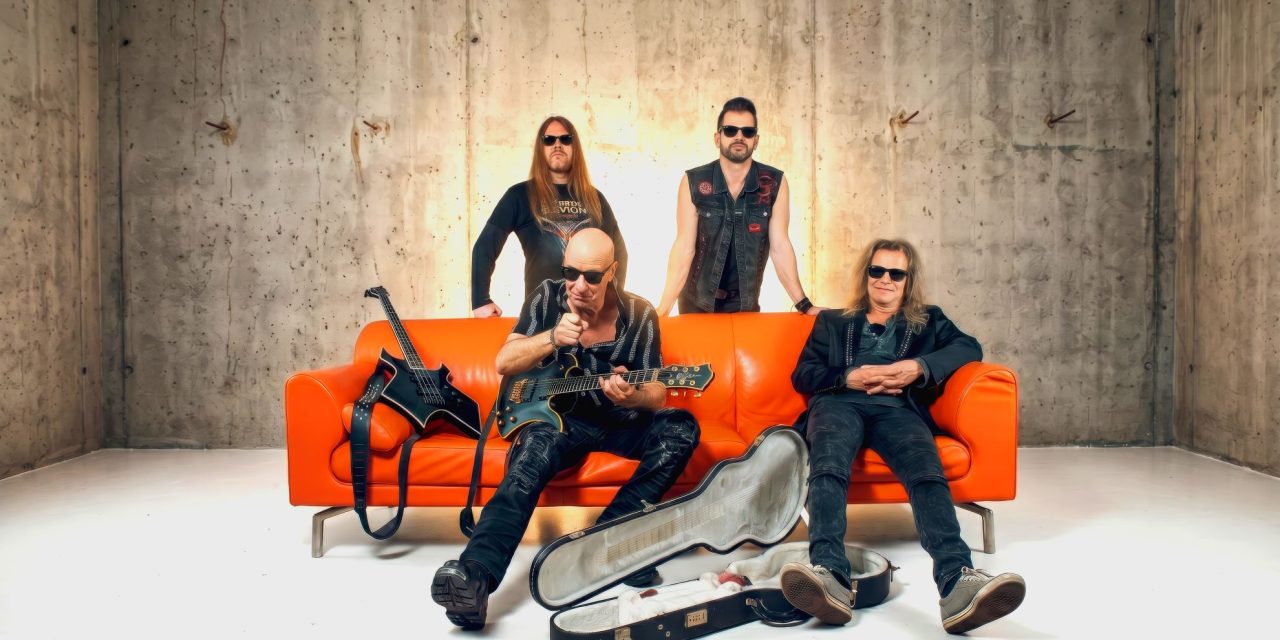
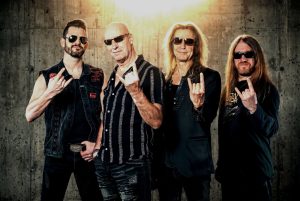
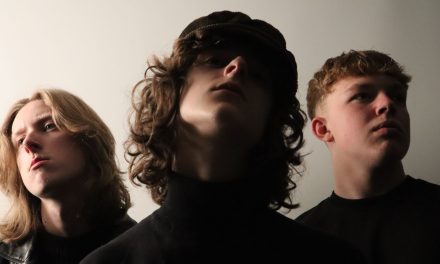
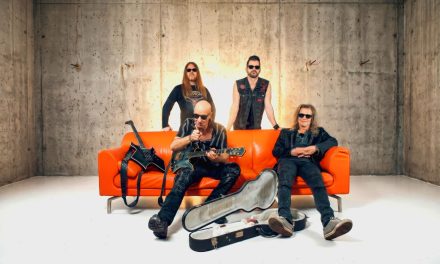
Photo by Thomas Sprengler
Through the Fires of Hell and Beyond: Piet Sielck Celebrates 30 Years of Iron Savior with Deathbringer
For three decades, Iron Savior mastermind Piet Sielck has remained one of power metal’s most distinctive voices, delivering anthemic songs, soaring melodies, and an expansive sci-fi saga that has captivated fans across the globe. Now, as Iron Savior celebrates its 30th anniversary, Sielck returns with Deathbringer (on Frontiers Music Srl), a powerful new album that reconnects with the band’s classic storyline while also reflecting on some intensely personal experiences.
During this conversation with Highwire Daze, Piet discusses the inspiration behind Deathbringer, overcoming cancer, the emotional significance of “Back From the Fires of Hell,” the success of Awesome Anthems of the Galaxy, guest appearances with Generation Steel and Terra Atlantica, classic Iron Savior album anniversaries, and his thoughts on returning to the United States. Honest, thoughtful, and often humorous, Sielck proves exactly why he remains one of metal’s most respected veterans.
We’re here with Piet Sielck of Iron Savior to discuss the new album Deathbringer. Is there any overall story or concept behind the title Deathbringer?
Yeah, it goes back to the original Iron Savior storyline that was established with the very first album almost thirty years ago. We are currently celebrating the thirtieth anniversary of founding the band, although the debut album itself came out in 1997.
Speaking of that anniversary, I thought that since there are a lot of people who are really into the storyline, it would be a good idea to focus a bit more on it than we have on recent albums. Deathbringer isn’t a complete concept album like the first four records, but at least six songs deal with the sci-fi themes and the epic story arc. So it definitely reconnects with something that began nearly three decades ago.
Let’s talk about some of the songs on the album. The first single is called “Back From the Fires of Hell.” Tell me a little about that song.
That’s a very important song for me. As you may know, in 2023 I received a very unpleasant cancer diagnosis.
On our previous album, Firestar, I wrote a song for my wife called “Through the Fires of Hell.” In that song, I was basically saying that I would go through the fires of hell for my wife because I love her so much.
But then, through a twist of fate, when the cancer diagnosis came, the roles became reversed. She was the one who had to go through the fires of hell with me. “Back From the Fires of Hell” reflects that experience.
Now we’re here in 2026, I’m still here doing this interview, and my wife contributed tremendously to helping me get through everything.
That’s wonderful to hear. And your health is good these days?
It is. Of course, I still go in for regular checkups, CT scans, and examinations, but so far everything looks good. It’s been three years now, and we’ll see what the future brings.
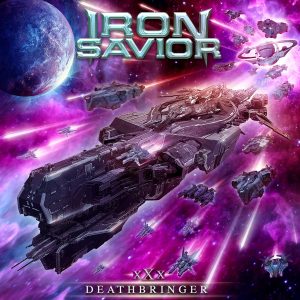
Deathbringer by Iron Savior
Absolutely. The second single is “The Creature’s Tale.” Tell me about that one.
That song actually goes back to a weekend when my wife joined me while we were playing a show in the Netherlands. Before the gig, we had some time to kill, so we were hanging out at the hotel watching Netflix.
The movie Frankenstein came on. I had heard about it, but honestly, I’m sixty-two years old and I’ve seen so many Frankenstein movies over the years that I wasn’t particularly excited about another one.
But it completely blew us away.
I think it’s an outstanding film, and especially the section where the creature himself speaks and the story is told through his eyes. For me, that was the most interesting part of the entire movie. The whole film is great, but that moment added a dramatic twist that I absolutely loved.
It inspired me to write the lyrics for “The Creature’s Tale.”
And since I think it’s one of the coolest songs on the album, we decided to make it the subject of an official music video as well.
One of my favorite songs on the album is called “Climbing Higher.” Tell me a little about that one.
“Climbing Higher” is probably the first song I wrote for this album.
It actually went through a lot of ups and downs because it’s a very commercial song, almost poppy in a way. It’s definitely not a traditional heavy metal track.
Because of that, I wasn’t sure if it might be too friendly or too accessible to fit on the album. But somehow it has a special spark. I didn’t reinvent songwriting or harmonic progressions with it, but there’s something about the song that makes me want to hear it again immediately after it ends.
That feeling stayed with me for more than two years, which is about how long the song had existed before the album came together.
In the end, I thought, if I still want to hear this song over and over again after two years, it must be good. So it made the album.
And there you go. That song really stood out for me.
Yeah, it’s a melody monster. I absolutely love that song.
 Let’s move toward the end of the album. Tell me about “Forever and a Day.”
That’s another song that’s tied directly into the storyline.
Explaining the entire story would probably take too much time, but it’s all written out in the album booklet and will also be available online.
In the song, the Iron Savior has to undertake something very dangerous, and there’s a possibility he may not return. Whether he does or not… who knows? It’s a bit of a cliffhanger.
Musically, it started with a working title that referenced Ozzy because the opening riff has a very Randy Rhoads-like feel to it.
It’s a little different for Iron Savior. It features double bass drumming, but it’s not full-on speed metal. It carries some great melodies and was actually a candidate for being one of the singles because I think it’s a very strong track.
I also have to mention “The Gunslinger,” which is one of my personal hidden favorites on the album. It deals with Roland Deschain and Stephen King’s The Dark Tower series, which I absolutely love.
You’ve also included a cover of Judas Priest’s “Fever.” What made you decide to cover that particular song?
Well, as the world knows, I’m a total diehard Judas Priest fan.
When Screaming for Vengeance came out, there were a lot of great songs we could have covered. We already did “The Hellion/Electric Eye,” and tracks like “Riding on the Wind” or “Bloodstone” would have worked as well.
But “Fever” always stood out to me because it felt a little different from the rest of the album. It has a unique atmosphere and vibe that grabbed me from the very first time I heard it, and it never let me go.
I had wanted to record it for years, but I never felt confident enough because of that incredibly high Rob Halford vocal section after the solo.
Ironically, over the last three or four years, I’ve developed the ability to sing falsetto parts that I wasn’t able to perform earlier in my life. Suddenly I found myself capable of doing those high-pitched screams without completely exhausting myself.
Once I realized I could handle those vocals, I thought, “Maybe now is finally the time to record ‘Fever.'”
And here it is on Deathbringer.
I have to admit that I’m a little proud of our version because I think it really does justice to the original.
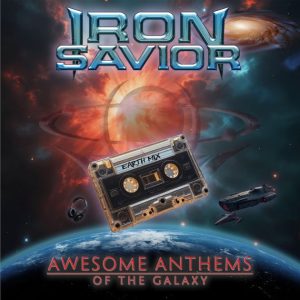
Awesome Anthems of The Galaxy by Iron Savior
Earlier this year you released Awesome Anthems of the Galaxy, which is a really fun album. How much fun was it to record, and how difficult was it to decide which songs would make the final tracklist?
Well, I’m sixty-two years old, so I’ve heard a lot of songs throughout my life.
It was really a matter of choosing songs that immediately came to mind. Some selections were obvious from the beginning. For example, Frankie Goes to Hollywood’s “Relax” was something I definitely wanted to do, along with songs like “Maniac” and “Fame.”
There were also songs that I sort of rediscovered because I had completely forgotten about them. One example is “When the Rain Begins to Fall.” It was a pretty big song back in the ’80s, but I had totally forgotten about it.
My wife and I were actually on vacation when it came on the radio early one morning while we were taking a taxi to the airport. It must have been four or five o’clock in the morning. As soon as I heard it, I thought, “That’s a great song.“
I had my guitar and some studio equipment with me on the trip. When I came home from vacation, the song was recorded. That’s pretty much how about half of the album came together. I’d hear something, think it was a great song, and immediately want to record it.
Have any of the original artists or bands you’ve covered heard the album or commented on your versions?
No, not yet. Unfortunately, Annie Lennox hasn’t called me and said, “Hey Piet, what a great version. Can you do it again?” (Laughs.)
But honestly, I’m pretty proud of that album. I think I did a really good job with the vocal performances, the harmonies, and all the background arrangements.
Of course, it would be wonderful to receive an email or even just a short message from one of the original artists someday. It hasn’t happened yet, but you never know.
Absolutely. Never say never. Two songs that surprised me were your covers of Irene Cara’s “Fame” and “What a Feeling.” What made you choose those songs in particular? I was especially thinking about Irene Cara, who sadly passed away a few years ago.
Yeah, when I heard that she had passed away, I was really sorry to hear it because she was a fantastic singer.
After hearing the news, I did a little research and learned that she continued to work in music, although more behind the scenes and not as prominentl as she had during her biggest years.
I’ve always thought she had an amazing voice, and I really loved both of those songs. For me, Fame was actually the first dance movie I ever saw.
At the time, I wasn’t a huge fan because I was completely into metal and considered everything else to be the enemy. (Laughs.) But the song stayed in my head all those years.
When I was choosing material for Awesome Anthems of the Galaxy, I realized that “Fame” is simply a great song. It already has a lot of rock elements, so I thought it could translate really well into a metal arrangement.
The same goes for “What a Feeling.”
For me, everything comes down to the chorus. The chorus is the most important part of any song. If the chorus hook doesn’t work, then it’s very difficult for a song to be truly great.
Both “Fame” and “What a Feeling” have incredible choruses, which is exactly why they made the album.
Definitely. Another song that works surprisingly well as a metal track is “Maniac.” What made you choose that one?
Actually, I didn’t know that Firewind had already covered “Maniac.” I only knew about the Avantasia version.
I think their version is good, but I would say I did a better job. (Laughs.)
The reason I chose it is that it’s actually a very metal-friendly song. The chord progressions lend themselves naturally to a heavier arrangement.
And of course, it’s such a well-known song. At least for people our age, the moment you hear “Maniac,” you instantly picture the movie scene. You see the training sequence and those famous close-ups of the taped feet.
That’s what I see, anyway.
If you’re making an album like Awesome Anthems of the Galaxy, then “Maniac” almost has to be included. It’s one of those timeless songs that everybody knows.
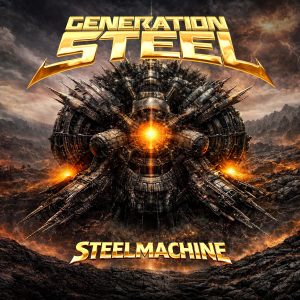
Steelmachine by Generation Steel
Absolutely. It’s definitely a classic. Coming back to the present, I have an interview with Generation Steel next week. You appeared on their album and performed on the song “Rise Up.” Tell me about working with Generation Steel and how that opportunity came about.
Well, my involvement with Generation Steel was primarily as a mixing engineer, although I also helped a little with production.
I already knew most of the guys. I knew Jack the Riffer because he toured with us and Mystic Prophecy a year ago as a support act, and he’ll actually be joining us again on the upcoming tour.
I also knew Thilo, and I knew Micke, the lead singer, from another project I had mixed before. He was singing in a band from Latin America called Fëanor.
I already knew Micke was a fantastic singer, so I was very happy when I heard that he was joining Generation Steel.
The band approached me about helping with production, and I agreed because I knew the people involved and I knew the quality would be there. I’m not interested in working on just anything. I need to believe that the final result will meet a certain standard, and with these musicians that was never in question.
So I helped out with some production ideas, worked on the vocal recordings, and provided feedback throughout the process.
At one point, Micke’s voice was becoming worn out, and there was a tight deadline because the release schedule couldn’t be moved. There simply wasn’t enough time to completely redo “Rise Up.”
The band then asked if my original demo vocals, which I had recorded as a guide for Micke, could remain in the final version as a guest appearance. I said, “Sure, let’s do it.“
So that’s how it happened.
That’s the story of how you end up doing guest vocals. You record a demo, and suddenly it stays on the album. (Laughs.)
I also wanted to ask about another recent guest appearance of yours with Terra Atlantica on the song “Through the Water and the Waves” on their new album Oceans. Tell me about that collaboration.
Well, I’ve known the band for quite a long time since they’re based here in Hamburg as well. I’ve known Tristan for years, and I think it was just about time that they asked me to contribute a few lines here and there.
It was fun doing it, and I also knew that with Eike producing and mixing the album, the final result was going to be excellent. There was really no doubt about that. So I thought, “Yeah, cool, let’s do it.”
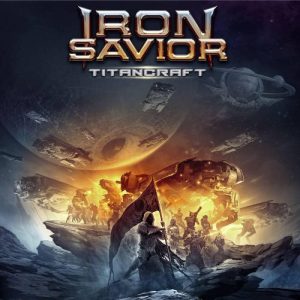
Titancraft by Iron Savior
Let’s talk about a few album anniversaries. Going back ten years, Titancraft came out in 2016. When you look back at that record now, what stands out to you?
I still think it’s a really great album.
It was actually the first album where I decided not to record live drums in a traditional drum room. Instead, we switched to recording with an electronic drum kit and MIDI drums.
From a production standpoint, that turned out to be a very wise decision because it made life so much easier. Having MIDI gives you incredible flexibility. You can exchange sounds, adjust everything later, and create a much bigger and more consistent drum sound.
If you listen to the albums that came before Titancraft, I think you can hear the difference. So from a production standpoint, it’s a very important album for me.
From a songwriting perspective, there are still songs from that album that regularly find their way into our live set. “Far Beyond the Horizon,” for example, is a song we’ve played quite a lot over the years. The same goes for “Gunsmoke.”
It’s also the final Iron Savior album that featured our longtime drummer Thomas Nack. After that, his work commitments and personal life simply became too demanding for him to dedicate the time Iron Savior deserved.
Of course that was sad, but at the same time it demonstrated his sense of responsibility toward the band and everyone connected to it.
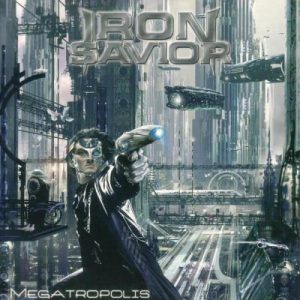
Megatropolis by Iron Savior
Looking back even further, Megatropolis will celebrate its twentieth anniversary next year. What do you think of that album in retrospect?
First of all, it’s very hard to believe that it’s already twenty years old.
When I think about Megatropolis, it still feels relatively new to me. But the reality is that it’s getting pretty old. (Laughs.)
One thing that helped change my perspective on the album was getting the opportunity to create the Megatropolis 2.0 version. I was able to remix it and make some production changes that I’d always wanted to make.
The issue I had with the original album goes back to the fact that I was also working with Savage Circus at the time. I wanted the two bands to sound clearly different from one another.
Savage Circus had a very epic production style with lots of keyboards, backing vocals, and layered arrangements. To separate Iron Savior from that, I intentionally scaled everything back on Megatropolis. The production became much more basic with fewer keyboards, fewer harmony vocals, and fewer overdubs.
At the time, I thought that was the right decision.
But after a year or so, I realized I wasn’t so happy with it anymore because backing vocals, harmonies, melodies, overdubs, and even keyboards are essential parts of the Iron Savior sound.
When you remove those elements, something is missing.
That’s why I was so happy when AFM Records called me years later and said they had run out of physical copies and needed to manufacture more. I immediately told them, “Wait a minute. If you’re doing that, I’d like to change a few things.“
That’s how the Megatropolis 2.0 edition happened.
The original album is still a good record, but bringing back all of those classic Iron Savior elements really helped the album become what I always wanted it to be.
And then, of course, there’s the biggest anniversary of all. Iron Savior has now been around for thirty years. Did you ever imagine it would last this long?
No, not at all.
When I founded the band and started recording the first album, I really had no idea where it would lead.
At that point in my life, I primarily saw myself as a producer and sound engineer. That’s what I thought my future would be.
But while working with all the artists who came through the studio, I began to realize that my own musical abilities weren’t nearly as bad as I had always assumed.
At some point, I thought to myself that I didn’t want to spend the next ten years wondering why I never even tried.
So I said, “Okay, let’s make an album and see what happens.”
Well, here we are thirty years later, talking about Deathbringer.
I certainly never expected that back then, but I’m absolutely happy that things turned out the way they did.
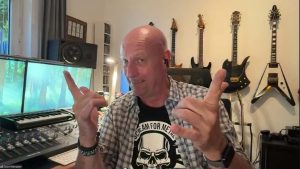
Piet Sielck of Iron Savior via Zoom!
Do you have any messages for your fans here in the United States who have been following Iron Savior for years? And maybe some hopeful news about Iron Savior finally making it back to the States?
I would absolutely love to return to the United States.
I’ve always had a very strong connection to America. My mother lived in San Francisco for thirty years, and I’ve spent a lot of time in the country over the years.
When I was growing up in the 1980s, the United States felt like the place to be. It represented opportunity, inspiration, and a kind of leadership that I really admired.
Over the years, however, I’ve become increasingly uncomfortable with certain political developments, and that’s something I’ve been very open about.
I know our decision to cancel some U.S. appearances created a lot of discussion among fans, but ultimately I felt it was important to stay true to my personal convictions.
I fully understand that many fans had nothing to do with those circumstances, and that makes the situation difficult because I would love nothing more than to come over and play for them.
I genuinely love the United States and the people there. My hope is that the political climate eventually becomes less divisive, and when that happens, I’ll be happy to return and play for everyone once again.
In Conclusion
Thirty years after launching Iron Savior, Piet Sielck remains every bit as passionate about music as he was when he first stepped into the studio with a dream and a handful of songs. Whether discussing the emotional inspiration behind Deathbringer, revisiting beloved albums from the band’s catalog, paying tribute to lifelong influences such as Judas Priest, or speaking candidly about his personal beliefs, Sielck approaches every topic with honesty and conviction.
With Deathbringer, Iron Savior not only celebrates a milestone anniversary but also delivers a powerful reminder of why the band continues to resonate with fans around the world. After surviving one of the most difficult chapters of his life and emerging stronger on the other side, Piet Sielck sounds more inspired than ever. For Iron Savior, the journey is far from over, and for longtime fans, that’s very good news indeed.
(Interview by Ken Morton)
Iron Savior on Instagram