


The Bard Speaks: Hansi Kürsch Reflects on 40 Years of Blind Guardian Magic
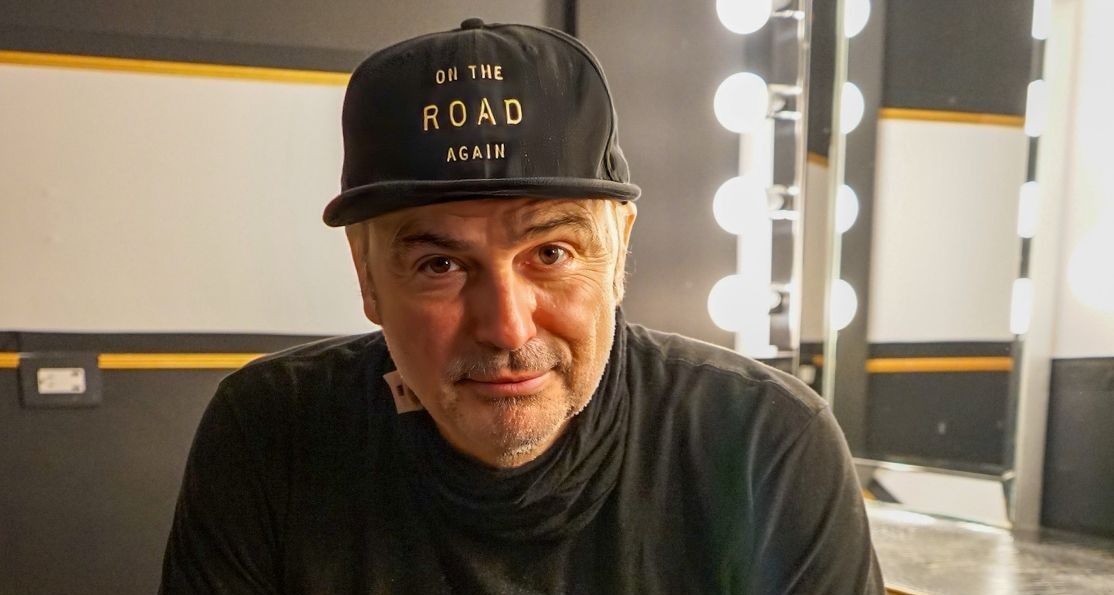
Hansi Kürsch of Blind Guardian backstage at The Wiltern
The Bard Speaks: Hansi Kürsch Reflects on 40 Years of Blind Guardian Magic
Blind Guardian have never been just another metal band—they’re a universe unto themselves. For nearly four decades, vocalist Hansi Kürsch has guided listeners through worlds of myth, magic, and imagination, all while helping shape the sound of European power metal. On the final night of the band’s Somewhere Far Beyond North American tour, just hours before they took the stage at The Wiltern in Los Angeles, Hansi sat down with us for a wide‑ranging conversation about the emotional end of a tour, the enduring power of their classic albums, the evolution of Blind Guardian’s storytelling, and even his unabashed love of Christmas music.
Relaxed, thoughtful, and characteristically candid, Hansi reflected on everything from the band’s early days as Lucifer’s Heritage to the upcoming 40th anniversary of Blind Guardian. What emerged was a portrait of an artist who still feels the same spark he did at 17—only now with a global fanbase spanning generations.
We’re here with Hansi of Blind Guardian. This question isn’t even on my list, but I’m going to ask it anyway. Today is the last day of your tour. What goes through your mind when a tour is coming to an end, especially one here in the States?
It’s always the same when you start a tour: a little microcosm forms. It’s this group of people you’re traveling with, and for anyone outside of it, it’s very difficult to enter. You feel protected within that bubble, and you rely on it for the whole tour, the whole season. Then suddenly, on the very last day after the show, there’s this hard cut and everyone goes their separate ways.
So the last day is a mix of relief—because we all want to go home—and sadness, because we genuinely enjoy each other’s company. Especially here in the States, where the run was great and people were really enjoying it. One eye is laughing, the other is crying.
As I said, no one else really gets in. If you’re part of the group, you belong to it for most of the run. But if you come in just for a moment, you won’t be able to participate in the same way, no matter how hard you try. And for us, letting an outsider in doesn’t work either. The people who are together for the whole run become like a union. It’s a very strong bond, and it’s something I love about touring.
Overall, this was a brilliant run—great audiences, a lot of fun, and luckily no one got sick enough to make us suffer. Usually it’s the vocalist who suffers the most, because once you catch a cold, you know you’re going to suck on stage. Luckily we avoided that this time. The band is highly professional and still improving with every tour, and that goes for the U.S. run as well.
The U.S. and North American tours—including Canada—are the closest you can get to a real old‑school road trip. Touring Europe is completely different. We know the culture, we know the game. Here, even if you’ve been to a place before, it still feels slightly different from what we’re used to, and that’s part of the adventure.
Hansi Kürsch of Blind Guardian backstage at The Wiltern
I think this is at least the second time you’ve played The Wiltern—the first time was with Demons & Wizards. What do you think of The Wiltern and your Los Angeles audiences?
Los Angeles audiences are great. With Demons & Wizards back in the day, we actually started the tour here, so it’s a perfect starting and finishing point. You know you’re going to have a good party.
With Demons & Wizards, not everything was prepared 100%, so you’re always a bit insecure at the beginning. But now, playing here at the very end of the tour, everything is in place. Everyone knows what to expect and how to adjust. That’s great—but we’re also carried by the audience, especially when we’re exhausted. The more tired we are, the more important a strong audience becomes, and Los Angeles has always delivered. For us, it’s a win‑win situation.
This is the Somewhere Far Beyond North American tour. Did you have to relearn any of the songs from that album, or were you nervous to play any of them live?
During the whole COVID interruption, we suddenly had time to kill. We didn’t know what to do, so we said, “Let’s celebrate Somewhere Far Beyond.” We re‑recorded the album, played some smaller shows in Germany, and then did a festival run. We performed the album at the big festivals in 2022, which was recent enough that we didn’t lose everything again.
Some of the songs have been played over the years, but not all of them. Playing the album in its complete form is always a challenge—but a pleasant one. It’s not a mission impossible. We grew up with that material. When we made that album, we were capable musicians and pretty good songwriters. It’s doable. If we tried to perform something like A Night at the Opera in full, that would be a challenge. But Somewhere Far Beyond feels natural.
We also realized there was interest in us returning to North America. We were just here last year with The God Machine, and it wouldn’t have made sense to focus on that album again. So this was an easy choice.
What really impressed us on this tour is how many younger people are in the audience. They weren’t even around in 1992 when we released the album—five, six years old, if that. It’s great to see how they connect with it and how much impact the album still has.
Of course, Somewhere Far Beyond was our mainstream breakthrough in places like Japan. It was a completely different era for us in Europe as well. It gave us a giant leap forward.
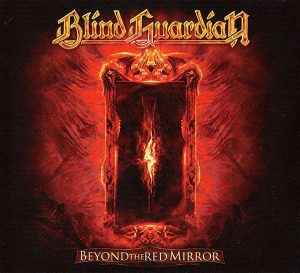
Beyond the Red Mirror by
Blind Guardian (2015)
Let’s talk about anniversaries, because you have quite a few of them with your albums. We’re going back 10 years to Beyond the Red Mirror. When you look back on that album—and all the massive orchestrations on it—what do you think of it now?
It’s a brilliant album. We actually did a remix of it that was supposed to be released this year, but because of some contractual issues we had to postpone it a bit. It’s ready to go, though, so you’ll get a different, more modern impression of it next year. I’m pretty sure it will be released then.
The remix really shows the beauty of the album. When we first started working on it, there were elements in the songwriting that reminded us of Imaginations from the Other Side—not copies, not even closely related, but there were connections. So we decided to make it a sequel to Imaginations in terms of storytelling. At the same time, we wanted a production style similar to Imaginations.
But because of the heavy orchestration, the final result turned into something completely different. Especially when you listen to the original mix from ten years ago, the references to Imaginations aren’t as obvious anymore, even though they were present in the core songwriting.
We also wanted the album to serve as a connector to Legacy of the Dark Lands, which came a few years later. So we exaggerated some of the orchestration on Beyond the Red Mirror. In the original mix, it appears more bombastic than the album actually is. It has a rough edge to it, and we hope the remix will bring that out more clearly.
In the orchestral version—or in the version you’ll hear next year—it’s a very enjoyable album. And if you go back to Somewhere Far Beyond or Imaginations, you can really hear how we evolved as musicians and how our approach to music has changed. I’m proud of that. I’m proud of all our albums, honestly. There’s not a single one where I’d say, “This sucks,” or that I have a major issue with it.
Sometimes I question minor things—maybe we didn’t give a song the full attention it deserved, or maybe we produced it too early and should’ve waited six more months. That happens. But all the songs on every album are part of the band’s legacy, a mirror of who we were at the time. And Beyond the Red Mirror is one of our strongest.
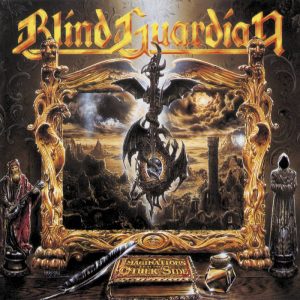
Imaginations from the Other Side by Blind Guardian (1995)
Now we’re going back 30 years to Imaginations from the Other Side—1995. It was such a turning point for Blind Guardian. What do you think of it now, three decades later?
For my taste, along with Nightfall in Middle-Earth, it’s still the strongest album we’ve ever done. Interestingly, when we were about 16 shows into a tour, we played the whole thing live here in Los Angeles. It’s a very important album.
But when it comes to live performances now—like tonight—I don’t think we’re playing any of the songs. And it doesn’t matter. We’ve composed so many songs over the years that at the end of the night you might not even realize, “Oh, they didn’t play anything from Imaginations.”
We did regret taking the song “Imaginations from the Other Side” out of the setlist, because there wasn’t room for another long track. That song is one of the most significant and important Blind Guardian songs ever.
It’s a great album, and it did a lot for us. I consider it our second-best, after Nightfall. Because of our long history, we’re lucky—we can give certain albums a rest so people can focus on other songs. We could also play the whole album and people would be thrilled. It’s another win‑win situation for us.
It was definitely a pivotal moment in Blind Guardian’s history. We changed producers and worked with Flemming Rasmussen—famous for his work with Metallica—and he gave us the push we needed. We already had a lot of international attention after Somewhere Far Beyond, and we had completely broken through in Japan. But with Imaginations, everything was elevated even further.
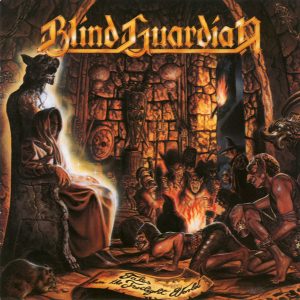
Tales from the Twilight World by
Blind Guardian (1990)
Now we’re going back 35 years—to 1990 and Tales from the Twilight World. When you look back on that album and the fact that it’s been 35 years, what do you think of it now?
That album came right at the edge of the heydays of heavy metal. The peak years were maybe ’84 to ’87—when everyone was crazy about metal and all the big bands were either starting their careers or hitting their biggest momentum. When we started in ’87, we were just a small band. Battalions of Fear and Follow the Blind were fan albums—and Tales from the Twilight World was too, in a way.
But with Tales, our third album, we really established ourselves in the scene. It contains brilliant songs. When we started working on Somewhere Far Beyond afterward, we actually had big doubts that we could make an album on the same level as Tales. That tells you something about how strong we felt that album was.
Even when we were writing the songs for Somewhere, I didn’t feel they had evolved dramatically enough to do justice to the new album. We played the demos for record companies and whoever else would listen, and the confidence only came when everyone said, “These songs are on the same level as Tales—or even better.” But we ourselves had such a strong impression of Tales that it created a lot of tension. It was maybe the only time in my life where I doubted whether we could improve that much.
Luckily, we went in different directions afterward, and I never had that feeling again. No matter which album we worked on, I always felt, “Okay, we’ll do the next thing, and we’ll be better—at least in some way.” But at that moment, I really thought, “Maybe this isn’t as good as Tales.”
Luckily, we had some standout songs on Somewhere Far Beyond that even outperformed “Lord of the Rings,” for example. Tales from the Twilight World is a fan-pleaser. We still play songs from that album today. And like with Imaginations, we don’t have to. A song like “Welcome to Dying”—it’s a great song, but we’ve never played it live.
Do you think the fantasy themes on Tales laid the groundwork for the more ambitious world‑building you’ve done on later albums like Imaginations and Beyond the Red Mirror?
It was an evolution—and a conscious decision after Battalions of Fear to go in that direction. Of course, Battalions has some political and historical criticism, but it’s also an album built on storytelling, musically and lyrically.
We always felt strong and confident about that approach because we were fans ourselves. We were geeky and focused on that direction. It never really occurred to us to go somewhere else—whether personal, political, or whatever. It was a collective decision. We talked about it, and it felt natural to us—not just in the scene, but in that specific type of songwriting and storytelling. It never came into question again.
Sometimes we do political songs, historical songs, philosophical songs—but in the end, everything is rooted in storytelling. We want to give people a good time. That was already obvious on Tales, and it pushed us even further into that geeky direction than Follow the Blind or Battalions of Fear did.
The role‑playing game crowd really connected with Blind Guardian because of Tales and Somewhere Far Beyond. That paved the way for our career.
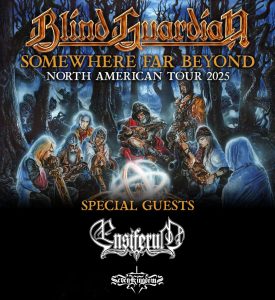
Somewhere Far Beyond North American Tour 2025
You’ve been doing Blind Guardian since 1987. In two years, it’ll be the 40th anniversary of the band. What has kept you so passionate about Blind Guardian and heavy metal for 38 years?
You can call it a profession, but it’s more than that. The German word for profession is Beruf, which comes from Berufung—a calling, a mission. That’s what it feels like. I’m sure there’s an English word for it, but I can’t think of it right now. It’s more than a job.
You choose this direction, you find out you’re good at it, you find out you get along with the guys in the band, and they share the same mission and vision. Then you just go. And even though I feel tired sometimes—when we hit the road and the first song starts—I feel old, yes, but I don’t feel the 40 years. None of us do.
If no one told us, we’d miss all the anniversaries. We’re not really aware that we’ve been in Blind Guardian for 40 years. And if you add the three years before that, when we were working together as Lucifer’s Heritage, it’s actually 43 years. It doesn’t feel like that.
I’m sure the Scorpions, the Rolling Stones, whoever—would tell you the same thing. Physically you feel different, your perspective changes, but your spirit and your thoughts still feel like when you were 17, 18, 19, 20. You’re not a completely different person. And the main thing is: if people don’t tell you, you don’t realize how much time has passed.
Would you like to do a fourth Demons & Wizards album?
That’s history. It’s history. I won’t do it. That’s all there is to say.
Since we’re in the holiday season, you released a Christmas song. Tell me about that song and how it came about.
In the band, I’m the biggest Christmas fan. Second—though not far behind—is Fredrik. He’s really into it too. Christmas has always been my celebration, my holiday tradition, and I’ve always loved it. My wife feels the same. And I enjoy Christmas music in general—classical, folk, pop, rock, whatever. I find my favorites in all of it.
I think I’m pretty good at recognizing who’s doing a Christmas song seriously or humorously, and who’s just trying to cash in. In our case, “Merry Xmas Everybody” by Slade was one of the great rock Christmas songs, and I always wanted to cover it. But I knew I had to convince Marcus and André—especially André, who’s even harder to convince than Marcus.
So I arranged the studio, arranged the producer, arranged everything… but I only had a rough idea of how we’d actually approach the song. I was relying on telling the guys—who aren’t really into Christmas music—at the last moment, hoping they’d say, “Okay, we’ll do it for you.” And they did. And it ended up being fun for everyone.
It’s difficult to get anywhere near the original, because Slade were a gigantic band and they knew exactly what they were doing. And we’re not naturally a band that plays in that feel—it’s not shuffle, it’s not boogie… it’s some kind of triplet groove I can’t even name. For a metal band coming out of the Helloween‑influenced era, that’s not the easiest lesson to learn. It took me a while to get into it.
But I had a vision of going in a Clash – London Calling direction. That helped me get into the right mindset, and it helped the guitarists shift into a slightly different mode while still keeping the spirit of the original.
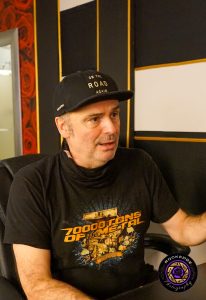
Hansi Kürsch of Blind Guardian backstage at The Wiltern
You have so many fans here in the States. Do you have any message for Blind Guardian fans who are reading this?
Well, first of all—thank you for supporting us. I’m really impressed by how the scene has evolved here. When we were touring with Iced Earth and signed to Virgin, the record company always said, “You won’t be successful in the States, so we’re not releasing the albums.” John said, “There is a market. There is a metal scene here that’s just as dedicated as Europe.” And over the years, I found out he was right.
People here are just as passionate about the music. The ones who are into what we do are truly die‑hard fans. And I’m so grateful that people who grew up with Blind Guardian in the ’90s and early 2000s are now bringing their children. And sometimes we see completely new people—maybe they discovered metal because of Stranger Things or something like that. There seems to be a renewed attention on this kind of music, and I’m very grateful for that.
Every night, I’m pleased to see people who know the songs, but also people who are metal fans in general and are just discovering Blind Guardian. That’s amazing to see.
It’s all generations. You look out into the audience and you see everything.
Absolutely. It’s a very diverse audience in almost every way. Blue‑collar people, students, kids, older fans—you name it. They’re all welcome, and I embrace them all.
IN CONCLUSION
As the house lights dimmed at The Wiltern and Blind Guardian prepared to unleash another night of myth and melody, it was striking how unchanged Hansi Kürsch’s spirit remains after nearly four decades. The passion, the curiosity, the humor, the devotion to craft — all still intact, all still unmistakably his. For a band whose music has carried fans through entire chapters of their lives, Blind Guardian’s endurance feels less like a career and more like a shared saga, one still being written in real time.
And if Hansi’s reflections reveal anything, it’s that the story is far from over. Whether it’s revisiting the albums that shaped generations, embracing new fans discovering the band through unexpected cultural moments, or simply celebrating Christmas with a Slade cover, Blind Guardian continues to evolve without losing the spark that made them legends.
As the tour wraps and the microcosm of the road dissolves once more, the connection between band and audience remains — spanning decades, continents, and now, generations. For Blind Guardian, the journey continues. And for the fans, the next chapter is already worth waiting for.
(Interview by Ken Morton – Photos by Karyn Burleigh of Rock Edge Photography)
Blind Guardian on Instagram